

02 · Pillar
Independent AI
Models designed, trained and owned in-house, with no dependency on a third-party provider for a deployed system to keep running.
Owned models · owned lifecycle · no external dependency
Independent AI is artificial intelligence designed to operate with the technological and operational autonomy appropriate to mission-critical industrial environments. Arkania designs, develops, trains and operates its own systems, owned at code, architecture and lifecycle level.
What independence means here
Independence is a specific and checkable set of properties, not a posture. It means the models are Arkania's own rather than someone else's fine-tuned; that the architecture is understood rather than consumed through an API; that training and re-training are capabilities held in-house rather than bought per run; and that the client ends up owning the model trained on their environment rather than renting access to it.
Each of those can be verified by asking a single question: if the provider ceased to exist tomorrow, what stops working? In a genuinely independent architecture the answer is nothing that is already deployed.
Why dependency is an operational risk
A dependency on an external model provider is usually presented as a commercial arrangement. In a mission-critical environment it is an availability characteristic, and it belongs in the same conversation as power and network.
The failure modes are not hypothetical or exotic. A provider deprecates the model version a deployment was validated against. Terms change in a way procurement cannot accept. A region becomes unavailable. Pricing moves. None of these are outages in the traditional sense, and all of them can stop a system that a plant has come to rely on, which is why, in this class of procurement, the question is asked before the technical evaluation rather than after it.
Sovereignty, data and the imagery problem
Operational imagery is sensitive by default. It shows layout, process, staffing, security posture and the state of assets, all at once, and much of it falls under regulatory or contractual restrictions on where it may go. In defence and critical infrastructure it frequently may not leave the operating organisation at all.
The trained model carries the same weight, which is the part that is often missed. A model trained on a client's environment has that environment's specifics encoded in it. Treating it as a deliverable the client owns, rather than as a service they subscribe to, is what makes the arrangement compatible with the constraint in the first place.
Scenario
A condition with no object in it
There is nothing here to put a box around. The entire reading is an area with a hard edge, traced where the water meets dry ground — and the area is the thing a drainage or flood-risk assessment is actually buying.
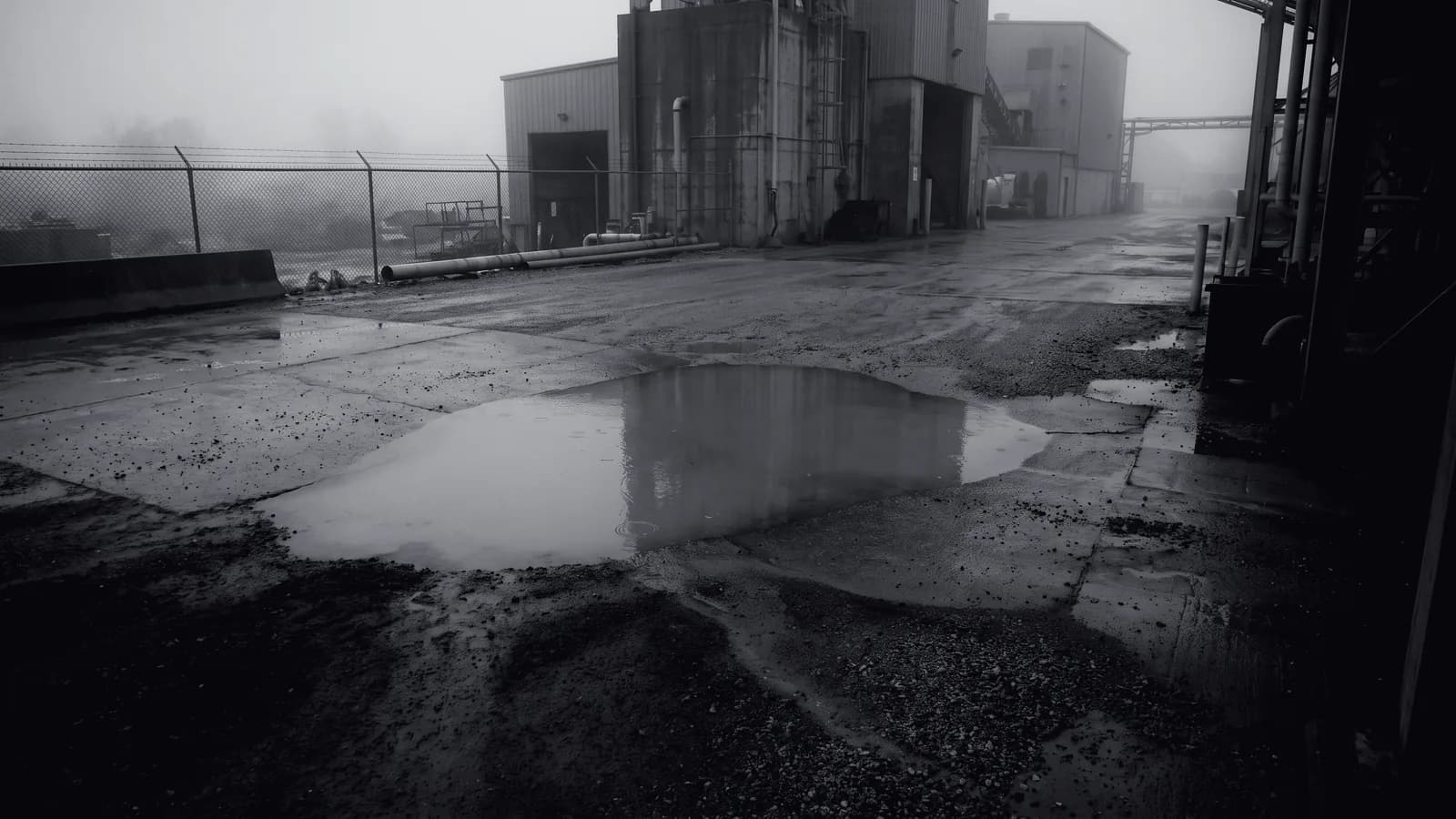

Illustrative analysis of this frame: Standing water, Structure.
Detected regionsRegion, normalised frame coordinates
- 01Standing waterScenarioX 0.17 Y 0.44 A 11.0% ∠ +3°
- 02Standing waterScenarioX 0.74 Y 0.50 A 1.1% ∠ +5°
- 03StructureObjectX 0.36 Y 0.01 A 10.0% ∠ −0°
The four properties
- 01Owned models
- Designed, developed and trained in-house, not a third-party model adapted and re-badged.
- 02Owned architecture
- Understood at code and architecture level, rather than consumed as a black box behind an interface.
- 03Owned lifecycle
- Training, re-training and specialisation held as in-house capabilities rather than bought per run.
- 04Client-side control
- Control over data flows, and ownership of the models trained on the client's own environment.
Interaction
The distance between two healthy things
The trees are fine. The line is fine. The clearance between them is the entire inspection, and it is drawn as a dimension running up through the gap rather than as two outlines with a caption between them.
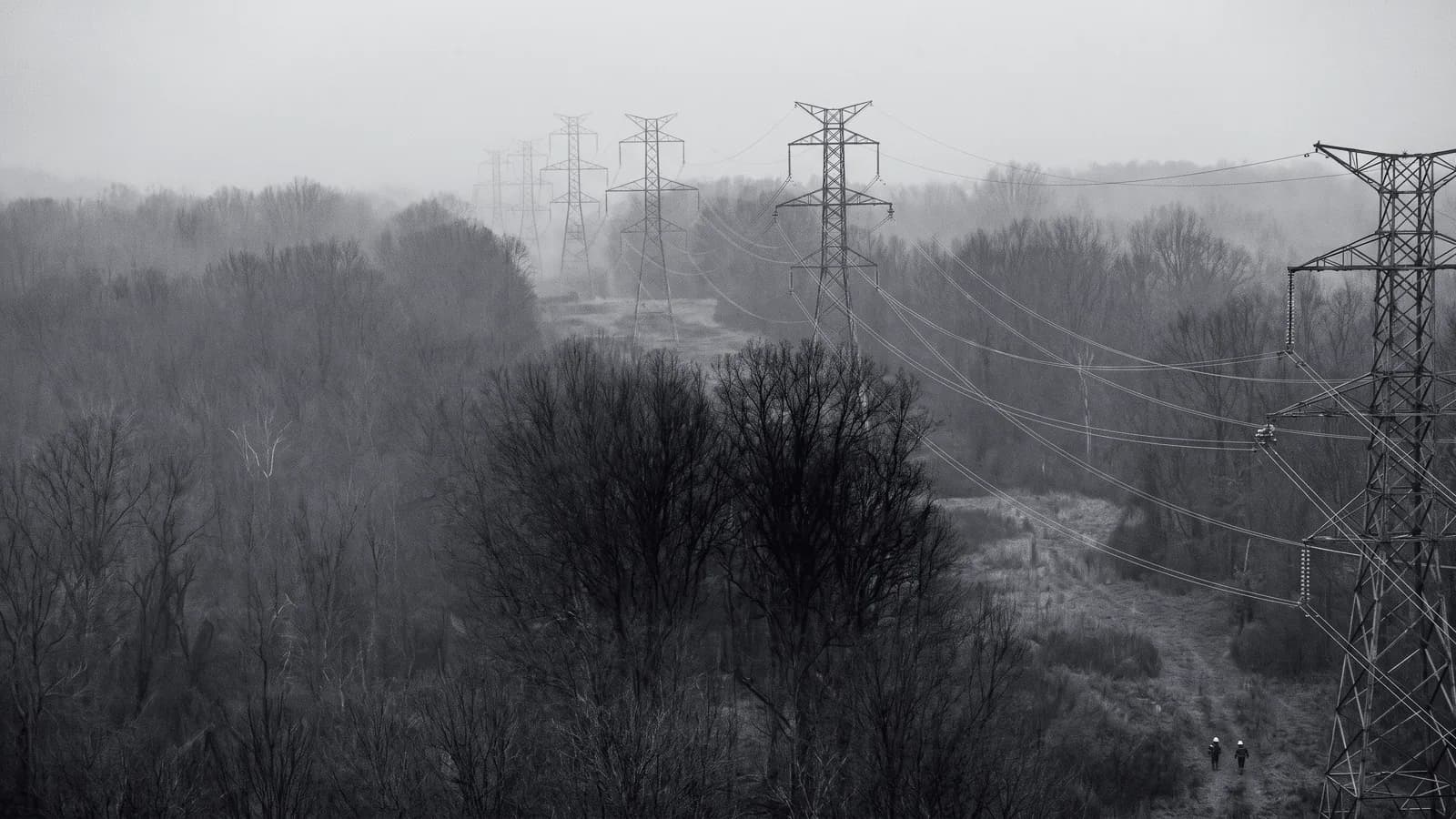
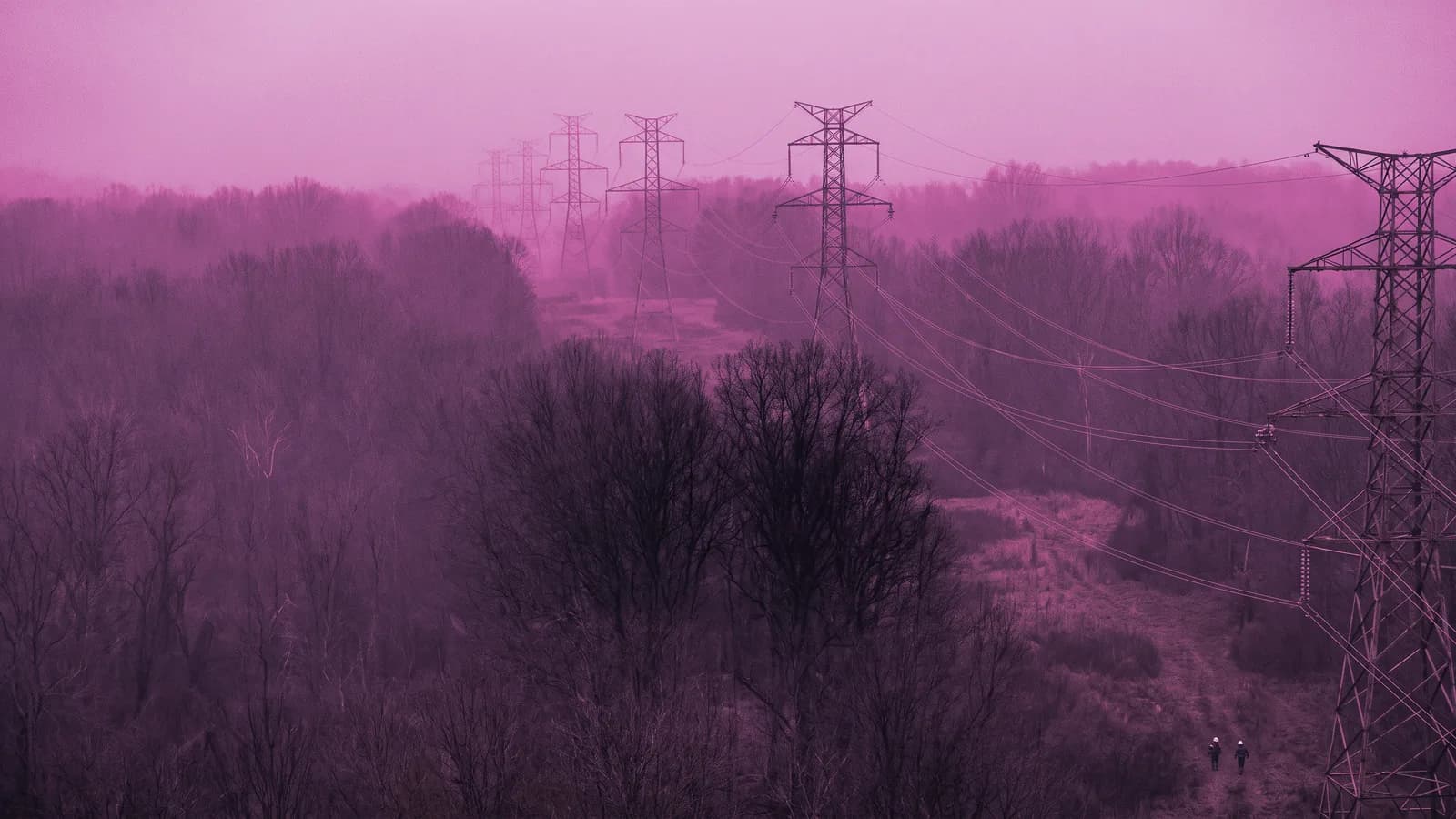
Illustrative analysis of this frame: Vegetation, Structure, Cable.
Detected regionsRegion, normalised frame coordinates
- 01VegetationScenarioX 0.42 Y 0.45 A 5.8% ∠ −1°
- 02StructureObjectX 0.57 Y 0.10 A 2.6% ∠ −89°
- 03CableObjectX 0.67 Y 0.20
Independence and deployment freedom
Owning the stack is what makes the deployment question answerable at all. Because the models and the architecture are Arkania's, inference can be placed where the environment requires: on-premise, at the edge on cameras, drones, robots and embedded devices, or in private and hybrid cloud.
A licensed model generally cannot go to those places, and not for technical reasons, the licence is what stops it. Independence is therefore not an alternative to edge deployment; it is the precondition for it.
What Arkania does not claim
Independence is a claim that attracts adjacent claims, and the adjacent ones are usually stronger than the evidence behind them. Arkania states what it can evidence: models designed, developed, trained and operated in-house, ownership at code, architecture and lifecycle level, deployment supported on-premise, at the edge and in private cloud, and client control over data flows.
It does not publish certifications it does not hold, air-gap guarantees for deployments it has not specified, or sovereignty claims framed as a jurisdiction rather than as an architecture. Those are established per engagement, in writing, against that engagement's own requirements.
Scenario
Two marks, one event
The stream falling from the joint is the leak. The wet patch under it is the consequence. They are drawn separately because they are separately measurable — a rate above, an area below — and because one blob covering both would report a puddle that happens to reach up to a pipe.


Illustrative analysis of this frame: Leak, Spill, Pipework.
Detected regionsRegion, normalised frame coordinates
- 01LeakScenarioX 0.50 Y 0.53 A 0.7% ∠ −80°
- 02SpillScenarioX 0.36 Y 0.79 A 2.6% ∠ +1°
- 03PipeworkObjectX 0.00 Y 0.32 A 6.3% ∠ −6°
Common questions about independent AI
What does independent AI mean?
That the models are designed, developed, trained and operated by Arkania, with ownership at code, architecture and lifecycle level, and no dependency on third-party models or black-box inference engines for the system to keep running.
Is any part of the system built on hyperscaler models?
No. There is no dependency on a third-party model provider for a deployed system to continue operating.
Who owns the model trained on our environment?
The client. A model trained on a client's operating environment is treated as something they own rather than as a service they subscribe to.
Does independence mean the system must run air-gapped?
No, it means the deployment is not constrained by someone else's licence. On-premise, edge and private or hybrid cloud are all supported, and the specific posture of a given installation is specified with the client rather than promised in advance.
How is this different from on-premise deployment?
On-premise is about location; independence is about ownership. A licensed third-party model running on your hardware is still a dependency, on its terms, its versions and its continued availability. Independence is what makes the location genuinely your decision.
Discuss requirements with the team
If independence is a procurement requirement rather than a preference, the specifics matter. Tell us what your environment has to satisfy.
Industrial and enterprise enquiries · EN / ES